THOUSANDS OF FREE BLOGGER TEMPLATES

pondělí 26. září 2011

Émile Zola: Thérèse Raquin (Tereza Raquinová)

   After quite a long time, I came back to the good old classic literature – when people got sued for what they wrote and when writing about sexual intercourse was really something different (where’s the fun today when no one minds a woman on a stage yelling I LOVE MY CUNT). Yeah, those were different times…when Zola was the most read French author, Baudelaire was more that “the only French poet I have ever heard of”, Madame Bovary was an upsetting novel and Maldoror walked the streets of Paris and forced dogs to molest little girls.
   The story has four main characters – Thérèse, Camille, Madam Raquin and Laurent. Thérèse grows up with her aunt Madame Raquin and her cousin Camille. Camille is a sickly, feeble boy and Thérèse spends quite a lot of time with him indoors, taking care of him. In reality, she has temperament and she would love to be running in the woods and enjoy nature. But little by little, she falls under influence of her cousin and Madame Raquin and submits.
   Later, she marries Camille but she is never really happy. Camille meets his old friend Laurent and introduces him to his family. Thérèse falls for him immediately and it doesn’t take long before they start a sexual relationship. Thérèse changes completely and the nice, calm girl turns into a crazy, passionate lover.
   Gradually, their relationship becomes obsession and they decide they want to be together. Obviously, there is a problem – Camille. Which may possibly turn out not to be such a problem. You just have to take him for a ride in a boat. And than throw him into the water. And than jump in and pretend you were saving his dear wife when the boat turned about.
   So far, the plan goes great. No one suspects them and they pretend not to care about each other. They even play Madame Raquin and her friends to propose the idea of their marriage.
   On their wedding night, they find out that this might not have been the best idea ever. They can’t sleep, they can’t sleep with each other, they actually can’t be in the same room. Such a situation is unbearable and drives both main protagonists into utter madness.
   This is the third book by Zola I have read so far and I liked it the best. I can’t really remember Nana, I read it a little bit too fast, and Germinal was good but a little slow. This one is short and something keeps happening all the time. Not that I would mind lack of story in books but in case of naturalism, you really need some that will catch you. It’s one of Zola’s early work, I believe it’s his first published novel, and he already uses his aesthetics of analysis and scientific approach to literature. But I guess we all know that.
   What seemed really interesting to me was that Zola was the first to realize (according to our literature professor) that human emotions are physical. There is of course insight into Thérèse, Laurent and Madame Raquin (interestingly, there is almost none into Camille…he is probably just too dull so even Zola didn’t care what he was thinking) but when they feel something, they feel it through their bodies. He goes in his analytic approach so far that his characters are based on four major temperament types. At least wiki says that Thérèse is choleric, Laurent sanguine and Camille phlegmatic; I dare say that Madame Raquin is melancholic.
   I think there is a lot to like about this book. Sure, there are those yucky parts some people could mind (like the description of Camille’s putrefying body) but you can’t read Zola without them… So if you get over them (or you skip them or you weirdly enjoy them) you get to his description of life in its brutality and savageness. Those people are hideous but they also can’t help themselves, it’s in their nature.
   The only thing I really disliked was the fact that Thérèse’s mother was from Africa. Given the philosophy of predeternism Zola uses in his work, her mother’s origin is a direct reason of her temperament and her savage and in a way primitive nature. Sure, using Africa as a symbol of barbarism and primeval instincts in humans wasn’t weird or offensive in that time (and few…many…decades later) but still…it feels weird nowadays.


pátek 23. září 2011

Douglas Adams: Holistická detektivní kancelář Dirka Gentlyho (Dirk Gently’s Holistic Detective Agency)

   I bought this book like zillion years ago to my Mum for her birthday or Christmas or whatever. She was reading The Hitchhiker’s Guide to the Galaxy and she loved it so I thought Dirk Gently would be a great gift. Unfortunately, she over-adamsed herself and she never touched this book. I thought that at least I should read it so it wouldn’t be a complete waist of money.
   I will be quite brief on this book, especially as I didn’t like it very much. The story begins with a weird, alien, mechanical monk who somehow gets on the Earth. He has no idea where he is and gets completely confused.
   The main hero, Richard, works as programmer and he comes to Cambridge to join a dinner with his old professors and to meet one of them and have a drink. After few hours, he realizes he was supposed to bring his girlfriend with him. While he is drinking with the old professor, a horse appears in the professor’s bathroom.
   Richard’s boss Gordon is murdered in his car. He leaves a message on his secretary’s answering machine. Later, he becomes a ghost.
   Susan is Richard’s girlfriend and Gordon’s secretary. They both piss her off. She has a dinner with Michael.
   Michael leads a little literary and art magazine. The magazine is not very good and his mother – the actual owner of the magazine – gives the job to someone else. Michael doesn’t like it. He is also an alien.
   Dirk sees someone climbing a building and getting into someone else’s flat. Later, he finds out that it was Richard and that the flat belongs to his girlfriend.
   Everyone thinks Richard murdered Gordon.
   There are more aliens involved in the story.
   There are also many quotation of Kubla Khan. Considering the end of the book, the poem is probably really vital for the story.
   I actually forgot the ending of the story. But I can remember I didn’t understand it. Someone wants to do something and someone else wants to stop him and travels in time and Coleridge is involved. Ehm. Maybe the problem is not in the book.
   Anyway, it was quite fun but it wasn’t anything special. I probably expected too much after the Hitchhiker. I don’t know what the problem is. I didn’t like the characters very much – Richard is boring and Dirk is an ass. The story didn’t catch me either. I really didn’t care who and why killed Gordon. It’s probably because it is not very good as a detective story (but it was probably never meant to be an actual detective story) – you don’t know anything about the victim and his surroundings so you can’t try to find the murderer on your own.
  It has good and funny parts but I never actually laughed loudly. And that’s what I expected from this book. Next time, I’ll take something by Pratchett, next time.

středa 21. září 2011

William Trevor: Děti z Dynmouthu (The Children of Dynmouth)

   Well, after a few weeks with no review, I am back. I read this book quite a long time ago so I can’t remember it very well. But I will do my best. We chose this book for our reading club, I had had no idea what it was about, who was the author…I really didn’t know what to expect. But the book surprised me – it is really good.
   It takes place in Dynmouth – an imaginary little town on English coast (in the exact place where Francis Drake destroyed the Spanish Armada…it’s probably somehow meaningful for the book, I just didn’t find out how exactly). The main character is a young guy called Timothy who spends most of his time on his own, watching telly. His mother and sister have to work and even when they are at home, they don’t pay him much attention. As expected, Timothy seeks attention elsewhere.
   As he has very little to do, Timothy browses the town and watches people. Unfortunately, he watches them more or less all the time (except for the time he watches TV) and with no regard to their privacy.
   There is an annual festival where people have different performances and they can win some totally worthy prizes (something like British Hillbillies Got Talent). Well, Timothy thinks he can participate. Not only participate, he can win. He makes up a funny scene about a serial killer and his three victims (young brides) who he drowned in bathtub. Obviously, no one thinks it would be even remotely funny but Timothy is resolved to get all the props he needs (a bride’s dress, a bathtub and a curtain).
   He may be a complete weirdo and the most antisocial guy in the town, but it doesn’t mean he’s stupid. He starts blackmailing his neighbours in order to get all those things and when they don’t agree to give what he wants…well, that’s when the real fun starts. Unfortunately, it doesn’t really matter if people obey him or not, he tells their secrets to everyone anyway.
   There is no point in describing the whole of the plot so I will proceed right to the core of the matter. Timothy is an ass (obviously) but he is a) still more honest than most of the town and b) unlike the others, he sees the life of the town as it is. On the other hand, he might see through people’s masks but when it comes to his own life and the way he lives it, he is just as delusional as everyone else. Another point of the book is that people never really change. Timothy forces some of the inhabitants into really tough psychological struggle, they get through it and than…they carry on as they always have. An lastly, Trevor shows not only particular stories but he also presents the town as a unit. There is an old crazy religious lady, a divorced couple, an unfaithful husband with a young mistress, an old couple, a spinster who has spent all her life waiting for her beloved man to leave his wife, etc. Not only you can find almost same pattern in basically every town and village, people themselves repeat it – the children in the story begin their way to become some of these people themselves.
   It’s not a very nice book. I really hated Timothy. I wanted the little sod to die (I somehow expected that someone will lose their nerves and do him in). People in the city are all weak and when he threatens them, they run or they just let him hurt them. But…that’s probably how it is.

pondělí 15. srpna 2011

China Miéville: Un Lun Dun (Un Lun Dun)

    I was in the Municipal Library with Awaris once and I found one of Miéville’s books. I told her it looked quite interesting and she replied that she has already read most of his work. Well, I don’t understand when she found the time for it but OK (it’s obvious she has a time machine and is too mean to share her secret with humanity). I really wanted to read some of his books and I finally had time for it and I loved it.
   It’s kind of Alice in Wonderland but modern and in urban settings. Two girls – Deeba and Zanna – accidentally enter UnLondon – a weird version of London where all things that become moil (mildly obsolete in London) or broken come and continue their lives. Unfortunately, UnLondon is threatened by the Smog – a cloud of effluvia (effluvia…that’s a cool word) which gradually gained consciousness. Zanna finds out that she’s the Schwazzy which is English transcription of choisi – chosen one (I will overcome my urge to correct everyone and do as if I have overlooked the fact that it should be choisie). The two girls are told to go to the Propheseers who should tell them what to do and help the Schwazzy to beat the Smog. When they arrive to the Propheseers’ bridge (after a trip in a flying bus and jumping across 2 metre high roofs) they meet the Book (basically, a big talking volume with inclination to deep depressions) and Brokkenbroll – the master of broken umbrellas. He and Benjamin Unstible – a Propheseers who everyone thought was dead – change old broken umbreallas into unbrellas – weapons against the Smog. But it doesn’t take long before things go very differently from what the prophecies say and it slowly turns out that unLondon might be rather in need of an unchosen one rather than the chosen (who will also need help – the too much talkative book, a half-ghost and a cuddly milk box).
   One thing I liked about this book is Miéville’s language. He is probably one of a few authors whose description didn’t bore me to death (it is quite difficult to be boring when you create a world where houses are built from old writing machines…but anyway). He uses a little difficult or less known words (not sure why, maybe it’s like Lemony Snicket who always puts in a definition of the word…Miéville is just for a little older readers…it’s a YA book). And he makes up his own words. Like binjas. I liked binjas. They are bins but also ninjas. Binjas kick ass. Language and language games are one of things which makes is so much like Alice in Wonderland. For example, the heroes enter the land of Mr Speaker who is the only one allowed to speak in Talklands. And every word he pronounces takes on physical existence (and crawls out of his mouth…yuk). He is complete control over them until…well, until Deeba says this:

“Well,” said Deeba, “don’t think word do what anyone tells them all the time.”
Hemi was looking at her with at least as much bewilderment on his face as Mr Speaker had.
“What are you on about?” Hemi said.
“YES, WHAT ARE YOU ON ABOUT?”
Deeba paused to admire about, an utterling like a living spiderweb.
“Words don’t always mean what we want them to,” she said. “None of us Not even you.” The room was quiet. Al the people and things in it were listening.
“Like…if someone shouts, “Hey, you!” at someone in the street, but someone else turns around. The words misbehaved. They didn’t call the person they were meant to. Or if you see someone at a party and they’re wearing something mad, and you say, “That’s some outfit!” and they think you’re being rude, u you meant it really.”
“Or…like if someone says something’s bad and people think they mean bad bad and they mean good bad. Or…” Deeba giggled, remembering one of the Blyton books her mother gave had given her, saying she had enjoyed it when she was Deeba’s age. “Or like that old book wit a girl’s name that just sounds rude now.”
The utterlings were twitching and staring at her. Mr Speaker was flinching. He looked sick.
(Unfortunately, Enid Blyton wrote like zillion books, so I didn’t find out which one Deeba speaks about).

   Another great thing about this books how imaginative it is. Mr Speaker is an example of it but there are piles and piles of great ideas (yeah, just like in Carroll). Well, long story short, it is a very good book if you’re looking for something funny and witty and you are in no mood for discovering the dark corners of human soul. I rest my case, just read it.
   Oh…one more thing. If you meet a giraffe…in night…and there are no bars between you and it…just run.

čtvrtek 11. srpna 2011

Paul Murray: Skippy Dies


   I have no idea how I cam across this book, I guess I must have read about it somewhere on the Internet. Than I asked my Dad to get it for me for Xmas and it was only now that I finally got to read it.
   There is not much of a story, at least there is no clear story line to follow (although the book has 660 pages). It’s more of a mixture of characters who are trying to somehow lead a worthy life (in which most of them…if not all of them…fail) or at least survive (in which some of them fail too). The story takes place in Seabrook – a prestigious Catholic boarding school in Dublin (it actually doesn’t exist but it is based on a school the author attended). The book presents us with POVs of several characters – mainly Skippy, Ruprecht, Carl and Howard. There are some other minor narrators, like Greg, the headmaster and evil incarnated; Father Green (aka Père Vert), a French teacher who hates French people and language, he hates teaching and most of all...he hates teaching French; and Lori, Skippy’s and Carl’s dream girl.
   Skippy is a student at the school, he’s 14 year old and for some unknown reason (later it is known, of course) he is so depressed he has to swallow handfuls of pills. He gradually falls deeper and deeper into depression until one day, he sees Lori and helplessly falls in love. Ruprecht is his friend and room-mate, a overweighed genius whose best entertainment is to sit in basement, trying to contact other intelligent species in Space. He tries to prove the string theory but after Skippy dies, he kind of loses it and tries make a contact with the beyond. Carl is same old as Skippy and Ruprecht but he’s a big, strong guy, a bully and a drug dealer and drug addict in one person. And Howard is their History teacher with a girlfriend whom he no longer loves who falls in love with a super-hot bitchy substitute teacher Miss McIntyre.
   The over-all feeling you’ll get from this book is a super-deep depression because this world is just fucked up beyond repair. All the characters try to deal somehow with this fact…mostly by getting high or drunk…or, in Ruprecht’s case, by eating piles of doughnuts. Sometimes, they get almost philosophical and reflect about life and world and Universe and Love and stuff and there are some really interesting ideas. The book mixes all kinds of moods – it’s funny, tragic, cynical and in a way brutal and disgusting in the same time. Sometimes it might be a little bit too much (one of Lori’s chapters will change your attitude to oral sex forever).
   But besides great characters and ideas, there is Murray’s excellent style. If you happen to teach about direct, indirect and all-those-between-direct-and-indirect speeches in English, use this book as your source text. On the other hand, it sometimes get a little confusing (especially Carl’s chapters lack quotations marks and sometimes they lack diacritics completely). He uses unbelievably wide range of similes – from biblical visions (used in really funny way – like when he describes Ruprecht putting his robot on floor as Moses’ mother letting her baby float in basket) to contemporary movies and computer games. He also has wonderfully imaginative, almost poetic language – mostly in the part when people are affected by drugs (I doubt there is any other book in which someone would describe eyes of someone on drugs in so many different ways).
   I really loved this book and if it weren’t so long, I would be sure to read it again sometime later. Hard to say if I’ll ever make myself re-read the whole novel but it is worth it. It was longlisted for Booker Prize 2010 so I really wonder what the awarded book is like because it should be frelling awesome if it beat Skippy… Anyway, there will be a movie next year so there should be a trailer soon. 


neděle 7. srpna 2011

42 Sci-Fi Challenge

The rules of 42 SF Challenge are simple:

Your mission--if you choose to accept it--is to read, watch, listen, and (possibly) review 42 sci-fi related items.

What counts? Short stories, novellas, novels, radio show episodes, television show episodes, movies, graphic novels, comic books, audio books, essays about science fiction, biographies about sci-fi authors, etc. Adapted or abridged works are okay as well.

Keep an ongoing list of your 42 either here on this site (just leave your email address in the comments) or on your own site (just leave a link to your list in the comments). Your list doesn't have to include links to your reviews. But it can if you like. Reviews are not required.


If you wanna join in, the wbsite to do so is here.

I will make a list of SF stuff I have seen and read this year and I'll try to add some reviews. Unlike in A to Z Challenge, I will probably write some of it in Czech. So, enjoy, here is my list so far:

1) Michel Houellebecq: Les Particules élémantaires (CZ review)
2) Brian Michael Bendis & Alex Maleev: Daredevil, vol. 1 (CZ Review)
3) Kurt Vonnegut: Slaughterhouse Five (CZ Review)
4) Slaughterhouse Five (1972)
5) Dark City (1998)
6) Towrchwood, Season 4 (2011)
7) Never Let Me Go (2010) (CZ Review)
8) Metropia (2009) (CZ Review)
9) Thor (2011)
10) Zombieland (2009)
11)  I'm Cyborg, But That's Ok (2006)
12)  Event Horizon (1997)
13) X-Men: First Class (2011)
14) Farscape, Season 1 (1999)
15) Alphas, season 1 (2011)
16) Haven, pilot (2010)
17) Ghost in the Shell 2.0 (2008)
18) Sucker Punch (2011)
19) The Day of the Triffids (2009)
20) Cloudy with a Chance of Meatballs (2009)
21) Doctor Who, Season 6 (2011)
22) Captain America: The First Avenger (2011)
23) Douglas Adams: Dirk Gently's Holistic Detective Agency (EN review)
24) Fullmetal Alchemist: Brotherhood (2009)
25) Farscape, Season 2
26) The Rise of the Planet of Apes (2011)
27) Farscape, Season 3
28) Arthur C. Clarke: 2001: Vesmírná Odysea (CZ review)
29) Fullmetal Alchemist (2003)
30) Fullmetal Alchemist: The Conquerors of Shamballa (2005)
31) Kit Whitfield: Bareback (EN Review)
32) Farscape, Season 4
33) The Fades, Season 1
34) Nikkarin: 130 - Odysea (CZ review)
35) Anthony Burgess: Clockwork Orange
36) Nikkarin: 130 - H.Z.O. (CZ review)
37) The Fades, Season 1
38) Super Eruption (2011)
39) Farscape: The Peacekeeper Wars (2004)
40) Doctor Who Christmas Special: The Doctor, the Widow and the Wardrobe (2011)

středa 3. srpna 2011

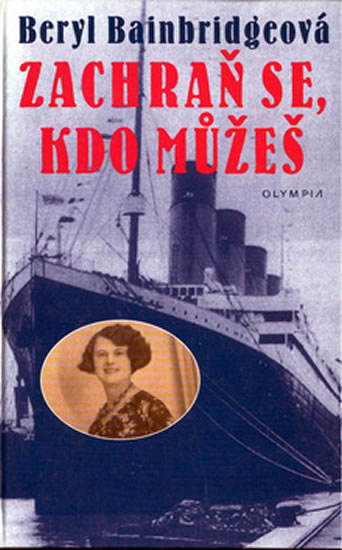
Beryl Bainbrige: Zachraň se, kdo můžeš (Every Man for Himself)

   We read the first chapter of this book at a literary seminar and than I chose to read it at our Reading Club. Nevertheless, there was a last minute change of plan and we will read something else.
  I wrote the fist paragraph of this review few days ago and I have to say I have been a little bit lost about what to write about this book since. I also forgot all the interesting things I noted when reading it (those I didn’t write down because they were all so clear and easy to remember…I’ll never learn). Anyway, I’m gonna do my best.
   Few interesting facts – it won the Whitbread Prize, the Guardian Fiction Prize and was a nominee of The Booker Prize. It treats the Titanic disaster and it was published the same year the movie Titanic went out. Many people probably believed the movie was based on this book and the success was great…I don’t think Bainbridge calculated like this when she was writing the book but still…lucky girl.
   The narrator’s name is Morgan and he’s a young, rich American. The story begins on the day of Titanic’s departure when a man, completely unknown to Morgan, dies on the street and gives him a photo of a Japanese girl. The reader doesn’t know from the beginning that the mentioned ship is Titanic but…there’s hardly anyone who has ever taken this book into his hands without knowing what it is about (and for those few who really did not know…the cover spoils the surprise anyway). The way Bainbridge reveals the name of the ship is one of the things I appreciated about this book. She feels no urge to dramatize new revelations. The name is mentioned only by the way and as if the reader was supposed to already have guessed it (he probably is). She doesn’t put it at the end of a paragraph or a chapter…the name just appears and you tell yourself: “OK, so I was right.” Nice change…
   There is not much of a story to tell. Morgan meets with bunch of rich people who all know each other…the world of wealthy is small. There are quite many characters and it might be a little difficult to get who is who at the beginning (ok, it’s not such a challenge but most of them turn up in one scene). A series of shorter episodes follows and it’s rather a mosaic of people and their characters than an epic story. Of course, the ship sinks but I felt like it wasn’t such a big deal for the author. It seemed to me that she used the catastrophe to make a morbid atmosphere rather than anything else.
   So, the book focuses rather on Morgan than on the story. He seems quite detached from the rest of his friends. One of the things is that his childhood wasn’t particularly easy one. His father died before Morgan was born and his mother followed few years after that. He spent some time in an orphanage and later his family found him and his aunt and uncle raised him. I am not absolutely sure but I believe that when they took him to their home he was old enough to remember it so he feels different from people who have always lived in wealth. The aunt and uncle didn’t really make it easier to him – for example, Morgan recollects that once he travelled with them on a ship but they were in the first class and he was in the third…quite clearly so that people didn’t know about him.
   But he is quite a likeable characters. Yes, he is detached and sometimes behaves oddly (he stole a picture of his mother from his uncle’s study) but he’s very ironical and pretty fun. Bainbridge’s style is another thing why this worth reading. You feel the whole time like nothing serious is actually happening. Titanic goes down. People die. Yeah, well. What’s next? She makes kind of morbid atmosphere from the very beginning – a man dies on the very first page of the book and the way she (or rather Morgan) describes it is quite cruel (the dying man holds on a fence and Bainbridge/Morgan makes a simile with an old scarecrow). There are also many moments when a character says something like “Yeah, but this ship is unsinkable” and everyone laughs. It’s not some extremely innovative idea but yet…it gives you the shivers.
   There is also kind of a detective story, because Morgan a bit by bit discovers some facts from is childhood. There are also different interconnected characters and events, sometimes rather implied than really said, so that’s interesting too.
    To summarize it, Every Man for Himself is an interesting book – it probably won’t sweep you off your feet but it’s still a good reading.